Last Days in Greece

Maria and I had our early morning flight back to Athens, completely sleep deprived and clutching cups of coffee as our lifeline that would see us through the day. Once at the airport we took the train to our old Athens hotel. Once there, we had a continuation of the same issue last time- they refused to allow our travel agent pay for our hotel. Maria and I resigned ourselves to a phone charge before I gave in and let them charge my card…no matter that I had already paid my travel agent the money. They wouldn’t take my Discover card, saying that their machine didn’t take it. I pointed to the receipt from last time that said otherwise, but their inability to be accommodating had them politely refusing to allow any respone but “no” now. I bite my tongue and paid with my Visa.

We fell asleep and woke up in time to go out to eat dinner, like real Millenials. Our late nights of partying with Greek gentlemen were coming back to haunt us, “Remember me?” We decided to eat dinner on the rooftop of our hotel, which had an incredible view of the Parthenon, alight with bright lights and glowing in the surrounding darkness, high in the mountain. There wasn’t a better sight in this city. Despite the frequent injustice of paying for water, it was another truly amazing night in Greece.

My photo was terrible, so I enjoy this stolen but properly cited one:
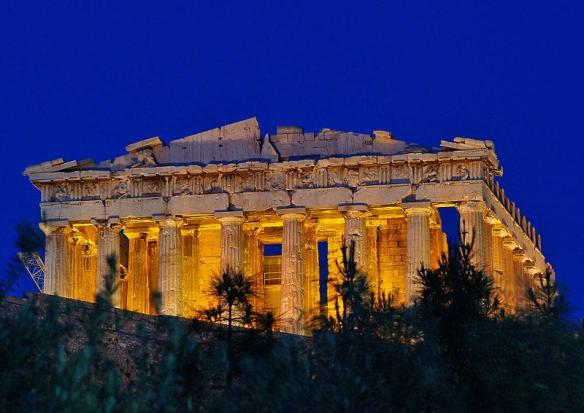
Parthenoni.

We spent the night enjoying the view, paying entirely too much for WATER, and enjoying our meal. Since our sleep schedule was off, we headed to the room and watched My Big Fat Greek Wedding on Youtube. It made so much more sense after being in Greece ourselves, moussaka, everyone being named Nico, the list went on. We finally fell asleep, to have one last day in Greece. ONLY ONE!

The next morning we were in a mad rush to be on time to the train station to go on a tour of the beautiful city we had neglected the first night we had been in Athens and the previous night before when we had chosen sleep over sights. Alas, it was not to be. We missed out train, close enough to see the doors shut and it starting to pull away. No doubt saying lots of colorful and child-appropriate words, I decided we would catch up with the tour group and join late. Maria was game, and we waited quite impatiently for the next train.

We arrived in time to watch the tour group begin to walk to the Tomb of the Unknown soldier, a rather unpleasant-seeming woman leading them all. She refused to let us join, said we were supposed to pay online and not in person (um, where? The pamphlet had not mentioned a website.) Feeling defeated, we walked away, wondering how on Earth we would see this historic, magnificent city now.

Onto the rescue, was a young woman handing out pamphlets for the Red Bus every major city seems to have. She offered it cheaper than the other woman (who had denied us anyway, but it was ok, we were in a better place now and deserved someone better) because I was a teacher. Not only would we be getting transportation around the city on a very hot day, but we would get a free tour that would be starting in an hour! Lucky us!

Before we left we observed the changing of the guard. I always find such dedication to duty impressive and patriotic, I wished I had joined the Navy or found a way to serve my country that way. Instead, I’ll continue dealing with the snotty teenagers and forcibly educating them. “You WILL love to read!”
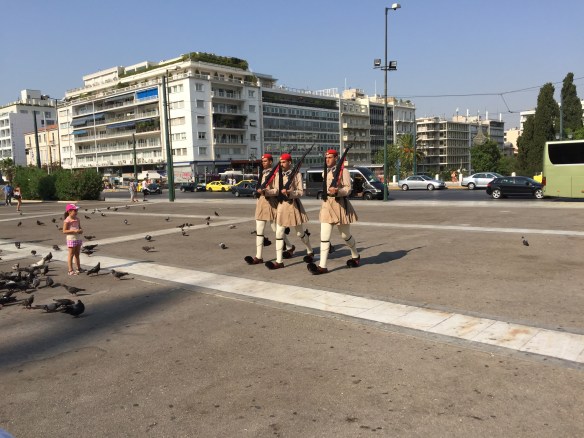
2016-08-02 10.00.56.jpg

Interesting costumes, eh?

The bus that might as well have been a luxury limo with a sunroof, led us through downtown Athens that we had barely squinted at when driving on a scooter through throngs of cars. We glimpsed the magnificent museum holding centuries of artifacts and history, statues of famous Greek actresses, government buildings, ancient houses, busy fish markets (those are still a thing?). We passed churches, the Temple of Zeus (of which I have a terrible picture, with those damn telephone lines obstructing our view), and Hadrian’s Arch.

Onto our tour!

Unfortunately, not enough people turned up for our tour, so we sat with the tour guide, an enigmatic man with a hooked nose and of course, glasses. You couldn’t have a Ph.D. without them, right? He hopped up when the clock hit the prescribed number, and began talking about the history of the region, and led us on a walk, talking all the while and giving me vivid flashbacks to my beloved History classes at UT Tyler. At one point, reaching the site of an ancient place of gathering and voting of the Greeks, the first democracy, I lost my breath.  He pointed out Alexander the Great had stood at this spot. I made a shocked, yet thrilled groan of excitement, and Maria shot me some side eye and said, “calm yourself,” and “are you having an intellectual moment over there?”

As our Intellectually Sexy tour guide pointed out, most tourists never come to this location, unaware of the significance it holds. If one were going to visit Athens, they must visit the Pnyx, and stand on that hill overlooking the city, surrounded by the dust and dirt of so many ages, the same dust that was between the toes of those early Greek voters. Bits of pottery littered the ground, one from each age in Greee. Our tour guide picked a few up and told us what millenium they were from, before discarding them into the dirt again.

From there our I.S. Tour Guide took us by a church, pointing out the pagan and Christian symbols that had merged on the outside, how one world had merged with the next. He took us to a ancient side people used to believe was the prison of Socrates before he was forced to commit suicide. It was actually an ancient fertility site, Philopappos Monument on Philopappos Hill. He gave us a great image of women coming there at night and howling like wolves, and drinking the water form the natural spring inside, supposedly granting them fertility.

From that tour we said goodbye to I.S. Tour Guide and hopped on a Red Bus headed to the History Museum. We only allowed ourselves two hours before we left, to make sure we could still make Acropolis. The sun was lower, and the light was incredible as we headed up the steps to the top of the hill.

The area was covered with a blanket of fellow tourists, traveling for hundreds of miles to see the Parthenon, sadly damaged by the Ottomon Turks in the Great Turkish War against the Venetians. It is still a magnificent sight to see, and I’m very glad to have been able to travel there.

Upon our return to the hotel, we got ice cream, which I don’t remember getting but the picture I have of us eating it and the relief from the heat we got. We felt our trip had been one of the better ones, and I would be sad to leave Greece.

The next morning, we tried to go swimming one last time (every time we had tried the water had been too cold despite the heat of the day continuing) and were disappointed one last time.

2016-08-03 17.54.54

We packed up our luggage and ate one last lunch, before heading out of our hotel. We took the train to the airport, the same as we had gotten from it before, but this time, the train was late, and stopped before the last stop, so we had to book it to the airport (and me with my luggage handle that refused to come out). We almost didn’t make it in time. We rushed through the airport, dodging people stupidly standing in the middle of the walkway chatting and oblivious to traffic, and made it to the gate in time. My luggage was flagged, so they searched it, making a mess of my clothes and making me worry we were going to miss our flight. Each flight attendant was disconcerted with my red, sweaty face, and told me everything was fine. Yet, when we reached our terminal, the flight just started boarding. We very well could have missed it.

The flight back wouldn’t end, stretching on in an impossible length of time. Two little, blonde, and friendly Canadian boys were seated to the right of us, both named respectively Leo and Alex. Now we had children to distract us instead of a couple obsessed with cheese. The boys laughed at the lines of caution from the flight attenants, reminders of exit doors in the front and in the rear. “In the rear,” they sniggered. “Are we in Toronto yet?” No, their father answered, they were in Munich. The boys were entertaining with their commentary and the little French phrases they would say. I was sad to see them go once we got to the Toronto Airport.
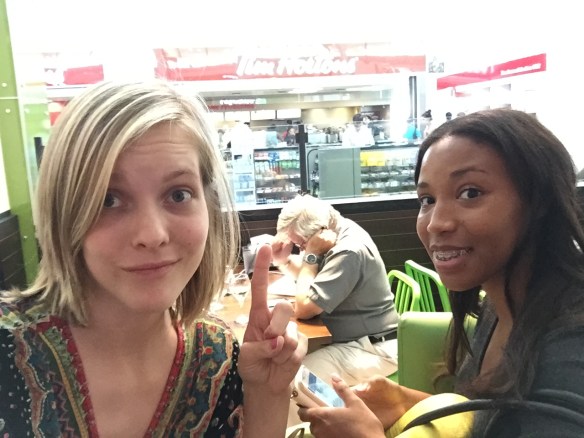
2016-08-03 18.43.56

Of course Maria and I had to eat at a truly Canadian joint once there, Tim Horton’s y’all! Maria texted Trey and begged him to clean his car seats of the perpetual dog hair before coming to pick us up. We got on our last flight and reached the US. Once there we had to go through customs, and when an Asian woman asked me to help her check in on the machines, I walked her through some of it. After another asked, I had to hurry and check in myself before I was mistaken for a worker.

When we finally stumbled out of the airport in Dallas, there was Trey waiting for us. I slept on the way back and woke up to find us in the Walmart parking lot. We went inside for basic provisions, and were greatly embarrassed to be seen with Trey because he insisted on driving a cart around the store.

2016-08-04 01.03.22

Five minutes later, we were at Maria’s apartment, and I fell fast asleep, grateful for the journey, but glad to be back in the good ol’ US of A.

i. Michael, Dr. “Parthenon at night.” Pixdaus, Pixdaus Ltd, pixdaus.com/parthenon-at-night-by-dr-michael-architecture/items/view/163701/. Accessed 19 June 2017.


Questions: The Black Sheep

“I’d need a court order. Even with a judge approving it, we shred the files every ten years. There wouldn’t be anything to find.”

That was the breathlessly awaited response I got to a request for information on the black sheep of my family-Emma Schulz Lipenski.

Everyone seems to have one. That grandmother who won’t stop muttering racist comments about your boyfriend under her breath, the uncle who hugs you a little too tightly at Christmas, and the parent that can be counted on to say something awkward about politics that will inevitably lead to verbal warfare over dinner. It’s natural, within social groups there is always a balance of harmony and strife that must be kept, and the black sheep are the daredevils rocking towards chaos with gleeful smiles.

For me, the black sheep that always interested me was the one no one spoke of except in brief one liners that hinted at more than they said, and that was Emma.

Schulzes

Emma Schulz

Born to poor German immigrants in 1895, Emma grew up in the small town of Yoakum, Texas. It was a town full of German immigrants like herself, which wasn’t a bad thing, not until 1914 when Germany began fighting the United States in World War I. Emma was nineteen when that happened, and no doubt, by now, her family realized what condition she was in. It wasn’t a good time to be German, or to suffer from the disease Emma had. As far as I have been told, by her nephew, my grandfather was that she had schizophrenia.

Who knows when it manifested? It could have been from age 18-22 as my psychology courses say is the most common, or as a child, which is more uncommon. Regardless, in hindsight it seems the family always knew something was different about Emma; that something was ‘off’ about her.

Emma Schulz

To me, this photo, one of the only photographs of Emma as a child hints at the unstable condition torturing her mind. Eyes that are strangely direct for her age, not posing standing, holding a doll, or posing with a family member, but with one finger in her ear and leaning on a tilted chair. Was she trying to block out the voices? Or is this simply a normal photograph, one that made a little girl in a big family happy to have when it was only of her?

Some of my questions can’t be answered, because no one is left alive to tell. All I knew was that the discovery of this photo, and seeing it for the first time, haunted me. Her pretty face, Cherub mouth, white bonnet over dark blonde hair and the old fashioned dress with a stiff collar is an image that would stay with me even if I lost the photograph.

Wild Child of the 10’s

As the young woman that she grew up to be, Emma began to act out in a way that was uncommon for girls at that time. She ran away from home, repeatedly, with young boys from the community or from others nearby. Her father would no doubt wearily pick himself up, and go after her, perhaps taking one of his sons to help. Her family recognized that she was unstable, but wanted to keep her home with them, where she would be safe and loved.

The family faced prejudice from the rest of the town. The German language was outlawed, and the family could no longer converse as they had been. Their thick accents and last name no doubt made them stick out like sore thumbs, and Emma’s condition, should it have been known, would further ostracize them from others. Even today, my grandfather does not like to talk about Emma. His mother did not approve of her, telling her son to never have anything to do with her. Emma was most likely not sent to school, as she could not read or write, according to a 1920 census. So a silence was built around Emma and her condition, leaving her feeling alone and misunderstood, and mute to the world around her.

Christian, Minnie, and Emma

Whoops…

Also in 1914, something happened that her family did not expect. Emma, who was unmarried, gave birth to a son, and named him Robert A. Stein. The last name was just an invention, as there was no man named Mr. Stein who had courted and abandoned Emma, or just ran away with her before her father fetched her back. No, the truth is much more complicated and sinister.

While the boy was publically given a name that didn’t belong to him, and perhaps this presented the situation differently to the public of the town, the father listed on the birth certificate was none other than her own brother, Albert Schulz.

Awkward family incest

Albert was a bachelor, and still lived at home along with Emma. My grandfather tells me he cannot be certain, but the implication as he understood it was that Albert hadn’t been listed as a cover or a convenience, but that he was most likely the father of Robert.

It is unknown, how the implications of her son’s birth played out within the family. There is no doubt Emma was further ostracized now, not only by the people in town but her family. Having a child out of wedlock was forbidden, taboo, the worst stain on a woman’s honor. Emma had gone one farther and had a child with her own brother. Black sheep indeed! Not forgetting of course her brother had taken advantage of her fragile state and loneliness. No doubt more of the blame was placed at Emma’s door, her record with wild behavior couldn’t have helped, but her brother had equal if not more of the responsibility of what happened.

Emma continued to live with her parents, brother, and son, an odd choice, seeing as what had already happened. In 1918, her mother, often cold, stern, yet loving, died of stomach cancer. Two years later, in the 1920’s census, Emma was listed with her father, brother, and child Robert. Interestingly enough, she is listed under a completely different last name than her family members now, referred to as “Emma Lipensky” misspelled as “Lepensky,” and listed as widowed. There is no marriage certificate on file for Emma, and none that I could find despite numerous searches. Later, Emma “Lipinski” is listed as divorced on the 1940 census record when she was kept in the Rusk State Hospital. Was she really married? Was it just a cover for her child, living proof she was not a “pure” single woman? Was there really a Lipenski? If so, did he die or was Emma forced to divorce him because she was not of her right mind, and her family did not want it to be out there that Emma not only had a child out of wedlock, but was also a divorcee? This was yet another of the numerous mysteries surrounding her life.

Orphaned and committed

Emma’s father was broken-hearted after he lost his wife, and died only two years later. With her parents gone, it is assumed that no one was prepared to board Emma and her son. Regardless of when, Emma was placed in Rusk State Hospital in Rusk, Texas, not far from where I live today. She lived a quiet life there, no records remain but for a 1940 census record, placing her there, and identifying her as divorced. Once again, it is unknown where the “Lipenski” comes from, or if it was even a legal surname. My grandfather tells me the medicine they prescribed her evened out her illness to the extent she could function normally. My grandfather said he believed it was lithium, but we can’t be sure.

2016-01-15 16.13.13

It is unlikely that the hospital would allow marriages within, between patients, and so I hypothesize that the marriage/fabricated marriage had to have happened between her parents’ deaths and placement in Rusk State Hospital. The “divorced” or “widowed” question could be answered with the social stigma or Emma’s unbalanced mind when it came to completing government documents. Her son Robert was most likely cared for by family, maybe even his uncle/father.

Robert entered into World War II, after legally changing his name to Robert A. Carson. He didn’t want any ownership to that name he had owned previously, and who could blame him? He left and never returned, his family never knew what happened to him.

His mother spent most of her life at Rusk State Hospital, the grounds beautifully covered with golden brown leaves covering old fashioned, carefully crafted white buildings with cracked façades, overlooking the spacious area. It wasn’t unpleasant, an outside look at least. I didn’t try to get past the opening gate; I didn’t have anyone to visit, and didn’t want anyone to tell me not to take pictures. It didn’t look like an unpleasant place to spend your time, but I’m sure the majority of her experience wasn’t tied up in enjoying the scenery, and have no idea as to the medical procedures and practices towards schizophrenics at the time.

Niece to the rescue!

Shortly before her death, Emma’s niece Oretha Mae Rice came to see her, the daughter of Wilhelmina Schulz, Emma’s older sister. She decided in an apparently unplanned fashion, that she was going to sign Emma out of the hospital. It is unknown when this was, but possibly after Oretha’s divorce in 1985, when she would have been lonely and it would have been more possible to have her move. Maybe she felt pity for Emma, having spent her entire like in the hospital. Maybe she was lonely, who knows?

Oretha drove Emma away from Rusk State Hospital, where she had spent decades of her life, to Beeville, Texas where her brother Jesse lived with his wife. Perhaps she took Emma around to the other siblings as well, introducing her aunt to her now extended family. Jesse knew who Emma was, and kept to what his mother had warned him, when he saw her and Oretha pull up to the house, he stayed in the porch swing next to his wife, and ignored them. Oretha saw he wouldn’t greet Emma, and drove away. He never saw her again.

Emma was entered to a nursing home in town by Oretha, and most likely visited regularly. It was when she had a regular visitor that she died on October 29, 1986 in Beeville, Texas, when she was 91 years old.

Emma Schulz Lipensky

There are some questions that will never be answered about Emma, or the role she played in her family, or even how her illness and actions were affected by the culture and time period she lived in. Most of her will remain a mystery, but at least I know I’ve found all I could.